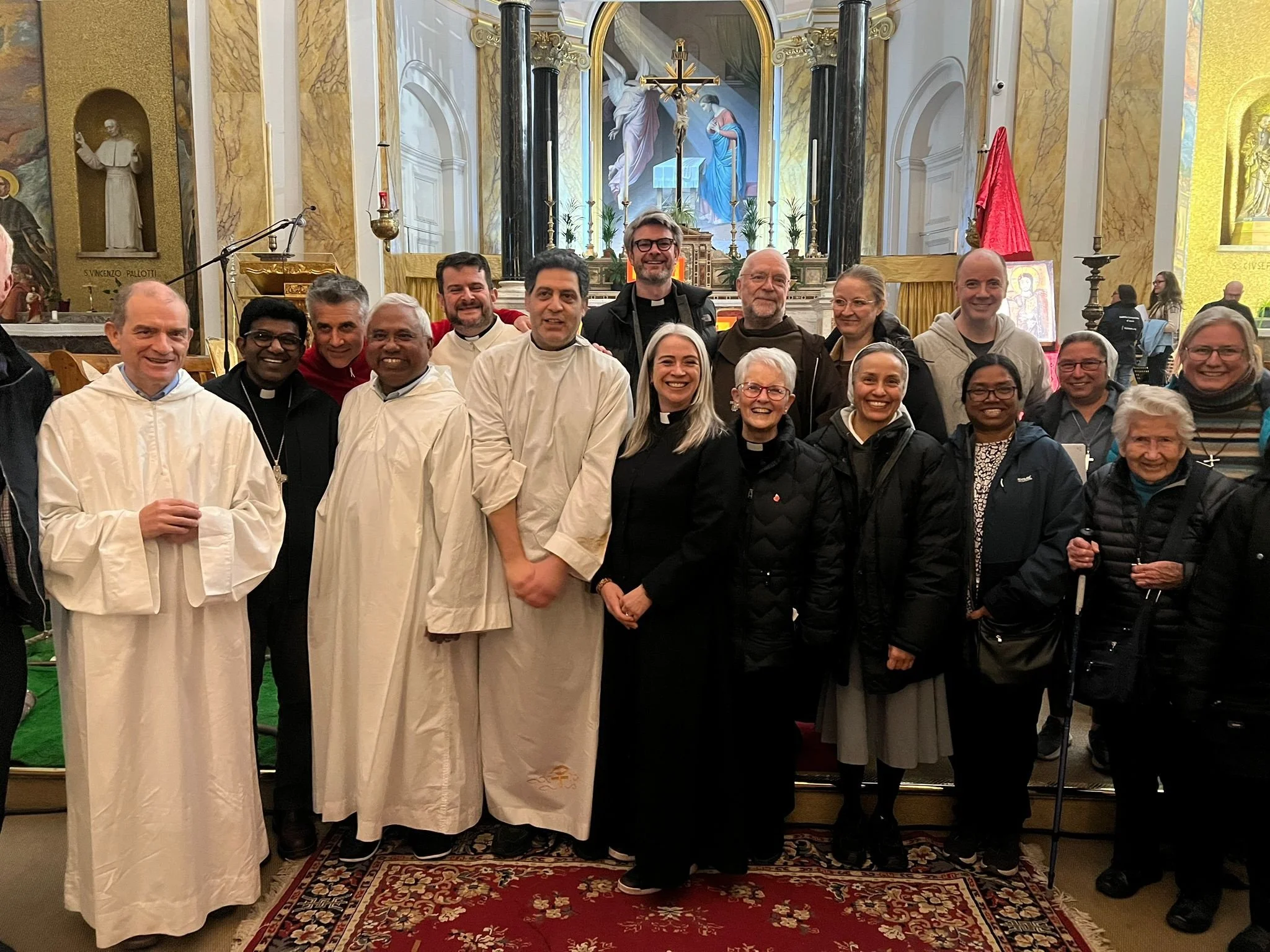
Br Vaughan from London writes, “Sister Sam and I attend a wonderful Taizé service. The Taizé community were visiting an Italian RC church in London following their presence at the installation of the Archbishop in Canterbury. The picture includes a couple of Taizé bros, RC clergy, CofE clergy and a couple of dodgy CFCs.”
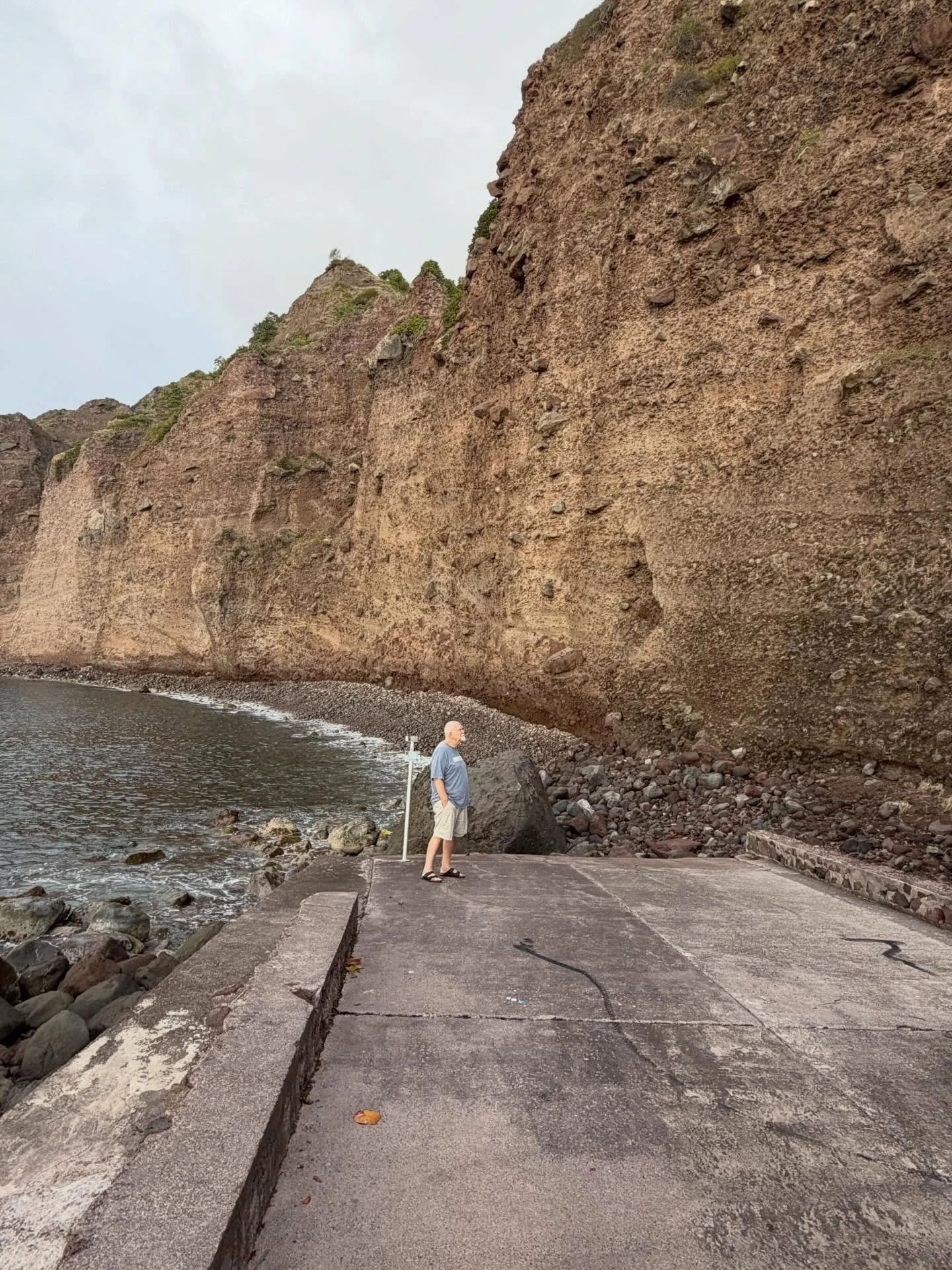
Greetings from the Netherlands Antilles and the Island of Saba
When I turned 75 and was the next month diagnosed with a rare cancer, I was pretty much thrown face-to-face with some questions I had never addresses before, or at least not with the same intensity. As a Franciscan, it wasn’t about asking God for some cure or healing but rather a challenge to attempt to go deeper into the healing that I believe is already available, present and life giving, no matter what outcome. I didn’t make any bargains around getting better if God effects a cure but I did make some promises to myself, with my wife Sarah, to try each day to live more fully in faith and hope, and engage with the “fullness of life” more deeply, or at least try.
So, sometime later, when I received a “random” email from someone I had never heard of describing an opportunity to serve the Church on a small island that I had never heard of, in an Anglican Diocese I had never heard of, well, I was, not exactly ready to jump in and engage in this “fullness” without a lot of questions being addressed... Oh well…
Over time, Sarah and I made the decision to jump in, and have faith that all will be well even though we continued to have many, many unaddressed concerns.
What goes around comes around. My first mission was in the Philippines on the tiny island of Biliran, where I was ordained a Deacon. Now, literally on the other side of the world from there, I, and this time with Sarah, am back on an even tinier island.
Saba is a municipality of the Netherlands. 5 sq. miles with about 1,500 permanent residents. Its prides include having two Dutch National Parks, one, the highest point in the Netherlands, a rainforest atop Mt. Scenery and the other, the pristine coral reefs which surround the island. Temperatures are between 73-83 every day, all year round. The first same sex marriage in the Caribbean was conducted here. And, what do you know, childcare, healthcare, education for all! There is one main road across the island that joins the port to the airport (boasting the shortest commercial runway in the world). The official name of the road is “The Road.” Dutch architects in the early 40’s said a road could not be built so the Sabans built it anyway and it opened in ’47, just around the day I, and my Sr. Warden were born!
We have two Anglican/Episcopal Churches, Christ Church in the Bottom and Holy Trinity in Windwardside. Christ Church was built in 1777 with Holy Trinity completed just a few years later! They are lovely, with a depth of real beauty that cannot be duplicated. While presiding and preaching I look down the mountain and out over the emerald blue Caribbean. Things are very simple here. Folks are incredibly warm and engaging. And though we may have 40 in the congregation (almost a full house) they sing and pray like we are 200!
God’s glorious creation is “in your face” and for that matter in all your senses all around all day! Sarah and I are limited to three months by visas but it is certainly an adventure that will be remembered. (Any of you clergy out there who might want to enjoy a peaceful time and be awakened each morning by the roosters, it’s worth consideration. Give me a call.)
A blessed 2026 to all!
Br Bob Flick
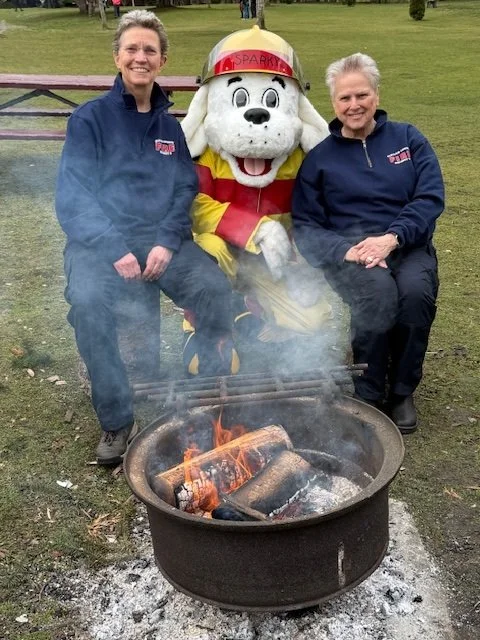
Sharing their Nursing Talents
Sr. Vanessa and Sr. Chiara volunteering at the Sequim Sunshine Festival (Sequim, Washington, USA) with “Sparky.” Each sister has volunteered to help their local community with their nursing talents.
Walking the Resurrection Talk
By Br Walt Hampton
Easter is coming. We sat we are Easter People. It’s the high holy day in Christianity. The centerpiece of our faith. The defining moment.
We say we believe in the Resurrection. And yet, it is a fairly unbelievable story. A dead man rising? It stretchs the limits of what we understand.
So, for many, the Resurrection stays in the background. A nice story. Abstract. Cerebral. Maybe historical. Maybe not. But distant. Yet, if we are followers of Jesus, we are called to follow him all the way. Life. Death. And Resurrection.
Resurrection is not just something that happened to Jesus. It is something that happens. Over and over. It is happening now. This is the heart of Franciscan theology. God is always breaking into the world. The Incarnation is ongoing. The Christ mystery unfolds in every moment. Birth, death, resurrection—again and again.
This is not metaphor. This is reality. Resurrection is not locked in the past. It is not a doctrine to believe. It is a way of life. We see it in nature. The seed falls to the ground, buried in darkness, and rises in new life. The caterpillar dissolves, disintegrates, and emerges with wings. The forest burns, only to regenerate with greater richness than before.
Death is never the end of the story. We see it in history. The Berlin Wall falls. Apartheid ends. The enslaved are set free. What was once declared dead rises again. We see it in our own lives. The loss that seemed unbearable, and yet we kept breathing. The failure that crushed us, and yet we learned and grew. The grief that swallowed us, and yet love found us again.
We have all known resurrection. Mary Magdalene experienced it that first Easter. She stood outside the tomb, weeping. Everything she had hoped for was gone. Jesus was dead. The story was over. And then—he called her name. Mary.
And suddenly, the world cracked open. She mistook him for the gardener. Maybe she wasn’t wrong. Maybe Jesus, the Christ, is the one who tends the garden of new life. Who brings forth what was dead. Who calls us out of the tomb and into the light.
The Gospel writers don’t tell us how the resurrection happened. They simply tell us that it did. And that it changes everything. If we are an Easter people, we cannot simply admire resurrection from a distance. We must walk the resurrection talk. That means choosing life. Again and again. It means looking for where God is breaking in. Where the Spirit is calling forth newness. Where love is rising from the ashes.
It means being resurrection people in a world obsessed with death. A world that worships power, clings to fear, hoards wealth, and believes in scarcity. Resurrection people do the opposite. We choose love over fear. We choose generosity over hoarding. We choose justice over indifference. We choose to believe that what looks like the end may, in fact, be the beginning.
This is not easy. Resurrection is not painless. It comes after loss, after grief, after death. It requires letting go of what was so that something new can emerge. But this is the way of Jesus. This is the way of life.
So here is the challenge. How will you practice resurrection? Will you welcome the stranger? Feed the hungry? Care for the marginalized? Call out injustice? Will you serve where there is need? Will you refuse to believe the lie that things will never change? Will you love without condition, without restraint, without exception?Will you tell your story so others can find hope?
The tomb is empty. Christ is risen. And resurrection is ours to live. May it be so.
Peace to you, Br. Walt

Why Living With Muslims Made Me A Better Christian
Jacqueline Taylor Basker
It took me over twenty years to get my Ph.D. due to multiple problems in my life. But I persisted after NYU said I took too long, although my advisers loved my dissertation in progress. However, Oxford University in the UK, through the Graduate Theological Foundation, then accepted me and I received my degree and soon my first full-time college teaching job. It turned out to be in Amman, Jordan at the NYIT campus there, teaching Art History and Art. My dissertation had been about the symbol of the cloud as a theophany in early Christian art, with studies of this symbol in Christianity, Judaism and Paganism, but post degree I had begun researching this symbol in Islam. So, an opportunity to go to a Muslim country was exciting. I left for Jordan in 2007 and I have never left It; I still maintain a shared apartment there and visit yearly.
However, when I woke up February 28 to the news of missiles flying over my home and friends in Jordan I was in a panic and shared that with my morning prayer group. I had come to deeply love and appreciate the people of Jordan. They helped me become a better Christian. The Call to Prayer 5 times a day from my local mosque reminded me to pray the Daily Office. Everyone carried prayer beads and prayed them frequently. This inspired me to get out my rosary and carry it around praying when I could. But most of all was the Muslim’s acceptance of the will of Allah. Almost every sentence ends with Inshallah. If God wills it. God’s will is accepted in all things, sorrowful or joyful, since God is in charge. If things were bad, it was deeply believed that God would one day remedy the injustice, violence, pain and suffering. This produced a character of both strength and focus in my Muslim friends. Added to this was the amazing self-discipline of Ramadan, fasting from sunup to sundown for a month. Even the Christians in Jordan have a much stricter Lenten fast then we do in the Western Church. Often Christians might fast with the Muslims during Ramadan. The relationship between Muslims and Christians is inspiring in Jordan. They marched together for peace when Isis began threatening Christians. In today’s polarized United States, the anti-Muslim bigotry is horrific and recently displayed itself with a mob attack against my NYC Mayor, Mamdani in his home.
Living in Jordan was a blessing for me; visiting the Baptism site and the many sacred Christian, Jewish and Muslim sites there is a pilgrimage of hope. Jordan’s history shows that the three Abrahamic religions can co-exist together. And our role model, St. Francis, visited the Sultan, al-Malik al-Kāmil, during the war of the Fifth Crusade and emerged pleading for peace. He got into trouble asking for peace, and his great prayer “ Lord Make Me An Instrument of your Peace “ is still needed today.
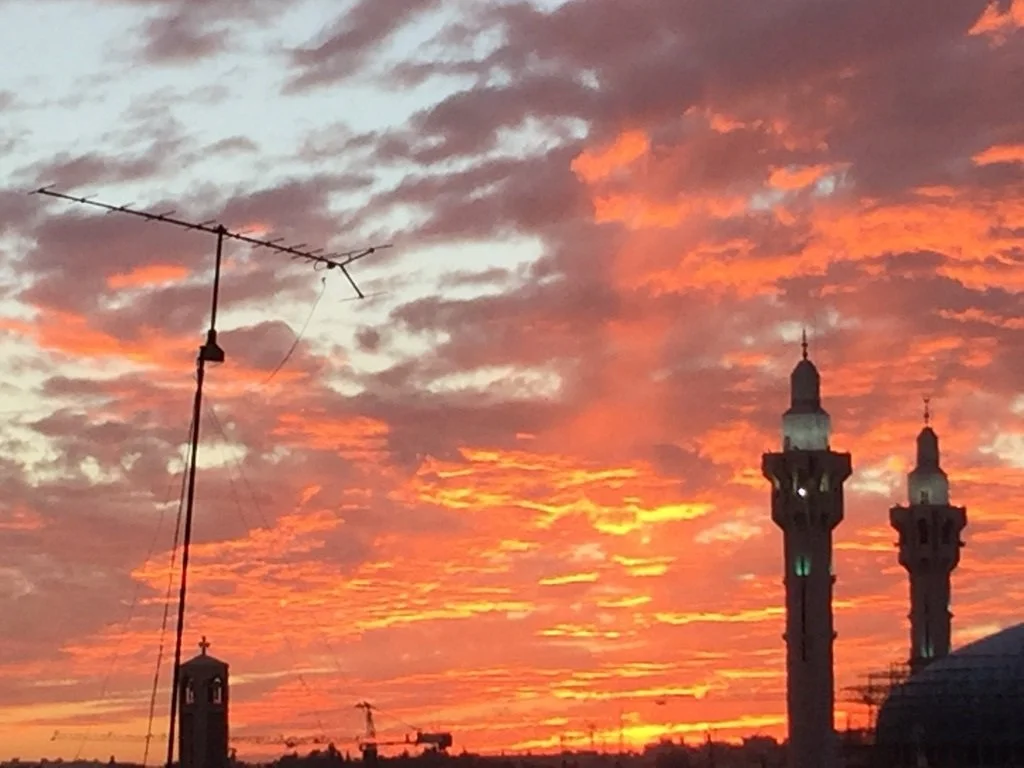
Picture from my terrace in Amman of the Spire of the Orthodox Christian Church (left) across from King Abdullah Mosque's Minarets (right) 2016.
Incarnation in Franciscan Spirituality
Br Bob Flick submitted the article below written by Seamus Mulholland, OFM entitled Incarnation in Franciscan Spirituality - Duns Scotus and the Meaning of Love.
John Duns Scotus (c.1265-1308) is one of the most important thinkers in the history of Christian thought, and an aspect of that thought is crucially relevant to our world today. More known as a philosopher of great insight and perception, his primary contribution to theology is little known outside the Franciscan order, yet is one of the most dynamically creative moments in the development of Franciscan theology and spirituality.
Though a profound theological and philosophical thinker, Scotus was first and foremost a Franciscan. His doctrine of the Incarnation (more fully known as the Doctrine of the Absolute Primacy of Christ in the Universe) is firmly rooted in the Franciscan intellectual and spiritual tradition, at whose core is the Person of the Incarnate Son as this is experienced in the radical evangelical witness of Francis. At the center of the life of Francis is the Incarnate Crucified Lord of all creation, whom Francis called our ‘Elder Brother’; at the center of the life of Scotus is the Incarnate Person of the Son, whom he calls ‘God’s Masterpiece’. In Scotus, the Incarnation is not a contingency plan when the original creative process of God goes awry because of sin. Scotus rejects this notion as too central an emphasis on Man to the extent that the freedom of God to act in love is determined by an external necessity i.e. the redemption from sin. Scotus understands the Incarnation as always being in the mind of God even before the historical and existential physicality of creation itself and the fact of sin.
The Incarnation is the model for creation: there is a creation only because of the Incarnation. In this schema, the universe is for Christ and not Christ for the universe. Scotus finds it inconceivable that the ‘greatest good in the universe’ i.e. the Incarnation, can be determined by some lesser good i.e. Man’s redemption. This is because such a sin-centered view of the Incarnation suggests that the primary role of Christ is as an assuager of the universe’s guilt. In the Absolute Primacy, Christ is the beginning, middle and end of creation. He stands at the center of the universe as the reason for its existence. In this sense the universe has realized its creational potential more than Man, since it is created with the potential to bear the God-Man and the Incarnation has taken place historically and existentially. Man, as yet, has failed to reach his potential to ‘love one another as I have loved you’.
Scotus argues that the reason for the Incarnation is Love. The Love of God in himself and the free desire that God has to share that love with another who can love him as perfectly as he loves himself, i.e. the Christ. Scotus says that all the souls that were ever created and about to be created could not, cannot and never will measure up to the supreme love that Christ has for the Trinity. The very fact of the preconception of the Incarnation in Scotus’s thought means that we are co-heirs to this Trinitarian love that Christ has. The Incarnation, then in Duns Scotus, becomes the unrepeatable, unique, and single defining act of God’s love. God, says Scotus, is what he is: we know that God exists and we know what that existence is: Love. Thus, if Man had not sinned Christ would still have come, since this was predetermined from all eternity in the mind of God as the supreme manifestation of his love for the creation he brings about in his free act. The Incarnation is the effect of God freely choosing to end his self-isolation and show who and what He is to that creation. The Incarnation, therefore, in Franciscan spirituality is centered on Love and not sin.
Sin has been given too much prominence in contemporary soteriology: God redeems from sin because he loves us?: no, says the Scotist, God loves us and then redeems us. Redemption is an act of love first and foremost, not an act of saving us from sin, and the first act of redemption is the Incarnation. God foresees us in union with him before he sees how sin disrupts that relational dynamic between He and us. Scotus makes it clear that the first movement is from God, a revelatory movement wherein God freely chooses to move beyond his own self-loving and share that loving with something other than himself – namely creation, and this process is epitomized in the Incarnation.
What the Incarnation shows us is not primarily the need for redemption, but the need that is in each one of us for love. That love which is so utterly free and unmerited that it embraces our own limitations, our own failures, our own hopes and longings and in uniting itself to us in the Incarnate Word in the person of Jesus of Nazareth elevates the human project to that which it always was in the mind of God. Scotus begins with Love, that love which is the very being of God himself, he travels the road of Love, which is made manifest in the Incarnation, and he ends with love, that love so hard to see in the misery of the abandoned Jesus on the cross, that Love which glorifies the whole creational project in the Resurrection.
Franciscan Spirituality sees the Incarnation as the guarantee of union with God. It is not something to be hoped for or to be looked forward to – it is something, which is happening NOW. God is Love and that Love is our redemption and redemption is not primarily being saved from sin, but is rather the gift of the possibility of openness to the experience of the divine Other in our life. How can it be otherwise when we posit the notion of the divine and human in Jesus? Scotus’s doctrine of the absolute centrality of Love is both timely and profoundly needed by our world. Men and women cry out for an experience of hope in a world which has lost direction – in the teaching of Duns Scotus, Franciscan Spirituality has within its hand that hope-filled experience and the end of that longing. For if God willed the Incarnation from all eternity, then it was always his intention to become part of sinful creation – sin determines the manner of that becoming, but it does not determine the fact that it was going to be. The incarnational thought of Duns Scotus needs a broader hearing, for it is pertinent to all Christians and the world, not just the Catholic tradition.
The Incarnation is of God, not Man. Scotus is indeed in the tradition of Francis and his incarnational theology is not complex – it is utterly simple: God is love and all that has been, is and ever will be is because God is love and is among us in Jesus among us in Jesus who is ever present.
Seamus Mulholland is a Roman Catholic Friar and lectures in Biblical Studies and Franciscan Spirituality at the Franciscan International Study Centre in Canterbury. This article was accessed from the Companions of Francis and Clare Secular Franciscan website at http://www.sfocompanions.org/
A New Priestly Calling
Two complementary “Calls” in the life of a Priest who is a member of a Religious Community.
When Saint Francis, in prayer before the crucifix at the ruins of San Damiano, heard Jesus speak to him, “Francis rebuild my church, which, as you see, is in ruins,” he took those words literally and began to repair the chapel. Later, he came to understand that he, and his friars, had been called to not only work with the stones in the Tuscan field where the chapel was located, but, in imitation of Jesus, to work with the “living stones” all around him to help strengthen, empower, and enable those stones-of the universal church-to carry out the mission of Jesus to teach, baptize, and invite to the table of the Lord. And yet, Francis never lost sight of those all around him—whom so many others overlooked; the lowly, the poor, the homeless, the naked, the destitute, the marginalized, the exploited, and the abused. In each of them, he recognized that the poor Jesus, born in a lowly manger, depended on the generosity of others, and had “no place to lay his head.” Like Jesus, Francis had an unshakeable trust in the abundant generosity of God and believed that God would provide all that he needed.
Later, Francis was ordained as a Deacon in the Church--and lived out that call to service through a ministry of feeding the hungry, clothing the poor, caring for the sick, and through numerous other acts of love and care. He also preached the Gospel fearlessly, and sought to do so--as much through what he said as through what he did.
It seems to me that Francis longed to become an icon, like that Cross at San Damiano, a point of connection with Christ. He longed to become transparent, so that others saw through and beyond him personally to the Jesus whom he loved with his whole being and whom he served with every ounce of strength that he had. Francis longed to share the passion and suffering of Jesus, and the gift of the stigmata on Mount La Verna, transformed his physical body—as an outward sign of the inner transformation which also took place. Quite simply, Francis longed to make real, present, and effective, the transforming love of Jesus the Christ in his own time, place, and culture.
The hymn of praise, “The Canticle of the Creatures,” made clear Francis’ own realization that all of creation is bathed in the light and love of God. Even more importantly, this hymn, written when Francis was sick, suffering, and preparing to embrace the reality of death, gave witness to his belief that, through, the Resurrection, Jesus had overcome poverty, illness, suffering, oppression, and even death.
In every generation since, women and men in almost every culture and place imaginable have followed the examples of Francis and of Clare but committing themselves to lives of simplicity, humility, and fidelity.
The Community asks very little of us, in terms of time, and involvement. Each month there is an online “gathering” on a Saturday, a monthly “Cluster” for a small group of Friars, and a “Formation” Session. Altogether this takes up about four hours. In Central Pennsylvania, there is a monthly “Franciscan and Friends” get-together on the first Monday of the month at the Mount Joy Friary (with lunch and prayer). I hope that, as weather allows, I will continue to participate in that time of fellowship. Most importantly, the Community gathers for Chapter for a week each Summer. It is a time in which we celebrate the Rites for those joining the Community and Progressing (Candidate, Postulant, Novice, and Profession of Life Vows). It is also like a family reunion for us—and a time to catch up with each other.
The Community of Francis and Clare is a recognized Religious Community (a dispersed Religious Community--not an Order) under the oversight of the House of Bishops of The Episcopal Church. The Rt. Rev. Laura Jean Ahrens, Bishop Suffragan of the Episcopal Church in Connecticut, is our Bishop Visitor. We are a member of NAECC (“NAECC is a coalition of Christian Communities recognized under the canons of The Episcopal Church working with communities in formation, dedicated to sharing and communicating the fruits of the Gospel — realized in a community — with the church and the world.”). To learn more about the CFC, here is a link to our Community Webpage—www.cfcfranciscans.org
If the vision of Francis and Clare to “rebuild Christ’s Church” is to be realized in today’s world, it must be rooted in the rich soil of the local ecclesial community. That means that it must be nourished, strengthened, and empowered by Word and Sacrament. That can only be realized through the ministry of those who have been called to Holy Orders in the Church.
In the Episcopal Church, the primary “building block” is the diocese. The Bishop is the chief pastor of the diocese, and of each parish—a community of faith, life, love, and service. Since she or he cannot be physically present in each community, since the earliest days of the Primitive Church, Bishops have called, and ordained persons to serve as their representatives in local communities. In the Episcopal Church, parishes prayerfully discern the person whom God is calling to serve as their Pastor. The Vestry then calls them, and after they answer the Call, the Bishop approves and appoints the Priest to serve in that parish. This process demonstrates the collaborative ways in which the Bishop, Priest, and Parish work together to accomplish the mission of Jeus to “reconcile the world to himself.”
Our Book of Common Prayer gives us a powerful insight into the reality of Priesthood in Christ’s one, holy, catholic, and apostolic Church. It gives practical guidance into the myriad ways that Priests are ordained to embody the vision of Francis and Clare to empower each “living stone” to fulfill their own vocation (each of the Baptized has an individual “Call” or “Vocation” to participate in the three-fold Ministry of Jesus as “Priest, Prophet, and King.”).
Two quotes from The Service for The Ordination of a Priest explain how every Priest, but most especially a Priest in a Religious Community is called to live out this complimentary “double call.” The Examination and the Consecration of the Priest (BCP, pages 531-534
“As a priest, it will be your task to proclaim by word and deed the Gospel of Jesus Christ, and to fashion your life in accordance with its precepts. You are to love and serve the people among whom you work, caring alike for young and old, strong and weak, rich and poor. You are to preach, to declare God's forgiveness to penitent sinners, to pronounce God's blessing, to share in the administration of Holy Baptism and in the celebration of the mysteries of Christ's Body and Blood, and to perform the other ministrations entrusted to you.”
“May he exalt you, O Lord, in the midst of your people; offer
spiritual sacrifices acceptable to you; boldly proclaim the
gospel of salvation; and rightly administer the sacraments of
the New Covenant. Make him a faithful pastor, a patient
teacher, and a wise councilor. Grant that in all things he may
serve without reproach, so that your people may be
strengthened and your Name glorified in all the world. All
this we ask through Jesus Christ our Lord, who with you and
the Holy Spirit lives and reigns, one God, for ever and ever. Amen.”
I conclude this reflection with a prayer which I composed, after a recent morning of service at a Breakfast Feeding Program in Harrisburg. “Beloved Jesus, you called Francis and Clare to rebuild your Church. Empower us to use the gifts, talents, and abilities which you have entrusted to us to make a positive difference in our world. Enable our eyes to see your presence all around us, and most especially in the poor, the marginalized, the weak, and the oppressed. Enable our hearts to love them as you love them and treasure them. Enable our hands and feet to serve them, and in serving them, to serve you. Amen.”
Saint Francis and Saint Clare, pray for us.

You will be like God
The first promise whispered in Eden was not about pleasure but about power. The “adulterous woman” of Proverbs is not merely the lure of flesh; she is the same ancient voice dressed in new colors—the desire to seize what belongs to God. Her invitation is self-worship disguised as freedom: intimacy without obedience, wisdom without humility. Yet the moment we reach for divinity apart from dependence, the garden empties. Paradise turns to exile; the bed of stolen sweetness becomes a tomb.
Proverbs functions not only as a manual for righteous living but also as instruction in just rule—a father’s legacy to a future king. The adulterous woman’s call echoes the serpent in Eden: “You will be like God,” becomes, “Come, let us take our fill of love until morning.” Both express the same grasping spirit: to take rather than receive.
The image of “another man’s wife” reveals the metaphor’s deeper meaning—lust not merely for flesh but for power, for the throne of God Himself. As Lincoln observed, “If you would test a man’s character, give him power.” And indeed, “power corrupts,” for the heart easily disguises ambition as virtue.
The Fall, at its core, is the story of human arrogance. Much of the Old Testament transmits truths through ancient oral traditions—the long apprenticeship of a people learning how to hear God. Across civilizations, kingship and divinity intertwined; even the papacy bears traces of humanity’s impulse to sanctify authority. Perhaps God, knowing the peril of this, sought to teach us early that only Love can rightly rule.
To love power is to commit spiritual adultery—to betray our covenant with God, with neighbor, and with Creation itself. God is God because God is Love, and only Love governs justly. History leaves no doubt that we cannot rule ourselves by pride.
Yet in Christ, God has given us the means to unlearn our arrogance and recover Eden—not by seizing, but by surrendering; not by becoming like God, but by belonging to God. The path home is not mysterious. It has already been walked. In Jesus of Nazareth—the Word made flesh—we are shown exactly how humanity was meant to live: humble, merciful, undefended, fully open to the Father’s will. Nothing in His way of life is beyond our reach, for He was as fully human as He was divine. His perfection was not flawlessness but wholeness—a life ordered by love, in right relationship with God, neighbor, and Creation.
To follow Him, then, is not to mimic the impossible, but to rediscover what we were always capable of. Eden is not behind us—it waits wherever love rules without pride.
Reflection by Leo Baird, CFC Candidate
A Spiritual Experience at Scala Santa
Since the first of September, Halloween decorations have been appearing everywhere in my neighborhood. It seems like more and more of my neighbors are following trends from their favorite retailers rather than adhering to the week of Halloween or actual month of October. The local Methodist church’s pumpkin patch just opened and their pumpkins are cooking in the Florida sun. The sign should read, “Get them now before they rot!” I’ve seen plenty of soft, moldy, blacken jack-o’-lanterns in early October.
One of the joys of traveling to Italy is not having marketing and advertising rush me into the next season. There was no mention of Halloween or Christmas anywhere in Italy. It was September and the Italians were holding onto the last remnants of summer as much as possible. There was no rush for autumn or winter.
My ghost story starts earlier this year in the Spring, around Easter. A local injury attorney firm in the area, I shall call them SG&F have dozens of digital billboards up around town along our highways. On any give week I pass several billboards with the faces of clients saying SG&F won them $30,000 or $100,000 after their accidents. But then there is the ghost who says SG&F won him $500,000. The first time I say him I thought it was the trick of my eyes. But as days and weeks progressed, I couldn’t deny it, the man on the bill board was the dead ringer for my late father. The wispy barely there dark blond hair, the glasses, the half-smile.
Intellectually I know it wasn’t my father but the man looks enough like him to make me feel uncomfortable and at times resentful. Here is the imagine of a man who never had time for me. Ironically, I only saw him at funerals, the last one being his. All summer I’d talk about it with God. Why does God want me to see this face every day while I sit in traffic. Does he want me to forgive my father? But how do I forgive someone I don’t really have any sense of hurt from? Am I to manufacture sadness or anger or hurt just so I can forgive him for not being my father? Because of his absence I was blessed by my maternal grandparents and uncle filling in for him. Instead of a nuclear family of two parents, I had four adults who raised me and cared for me.
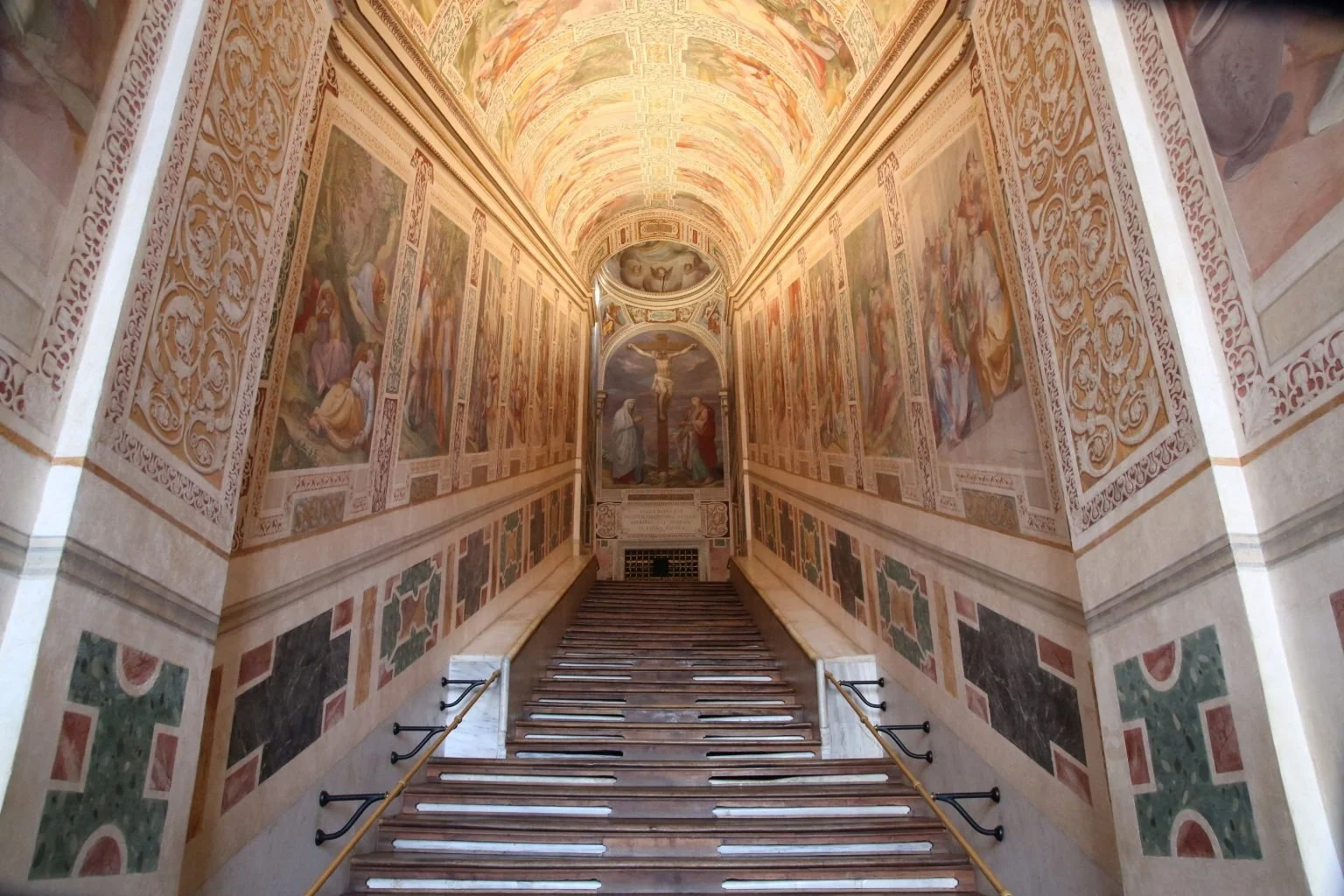
On one of my mornings in Rome, I visited the Scala Santa. According to tradition, Emperor Constantine’s mother, Helen, brought these stairs from Pontius Pilate’s palace in Jerusalem. It is believed that Jesus was led up these stairs to his trial. Roman Catholic tradition holds that climbing the entire staircase on one knee leads to a plenary indulgence, a full remission of temporal punishment for sin for oneself or for someone in purgatory. As a former seminarian and a reader of Luther’s works, I recognize the complexity of the concept of indulgences. Nevertheless, I sought to engage in a meditative practice that would enable me to accompany Jesus on the very stairs tradition says he climbed during a time of his profound anxiety.
I soon learned it was not so easy as I thought. I was soon crying as I slowly and painfully climbed those stairs. My knees sank into the bones of my legs and into the wood and grit of the stairs. The acrid smell of my own pain filled the air, mingling with the body odor of others. The dirty soles of shoes inches from my face made me gag and claw my way out from the claustrophobia, and I felt dizzy, yearning to lie down and weep.
But I kept going. By the halfway mark, I really wanted that full remission of temporal punishment! I wanted to make sure I didn’t have to suffer this kind of pain again. I never knew so much discomfort, even after surgery! Just then, my father’s face came to my mind’s eye. I prayed out loud then on the stair that I offer up any remission of temporal punishment for my father, and I cried. I cried for the remaining steps and in the chapel at the top.
Since returning to Miami, I rarely catch a glimpse of the man's face on the digital billboard. I believe God allowed me to see this face so that I could pray for my father and endure the emotional turmoil of climbing those stairs, offering up its spiritual benefits for his soul and finding emotional closure.
Pace e Bene,
Br. Carlos Roberto Fernández, CFC
The Chapel of St Peter-on-the-Wall and its personal significance
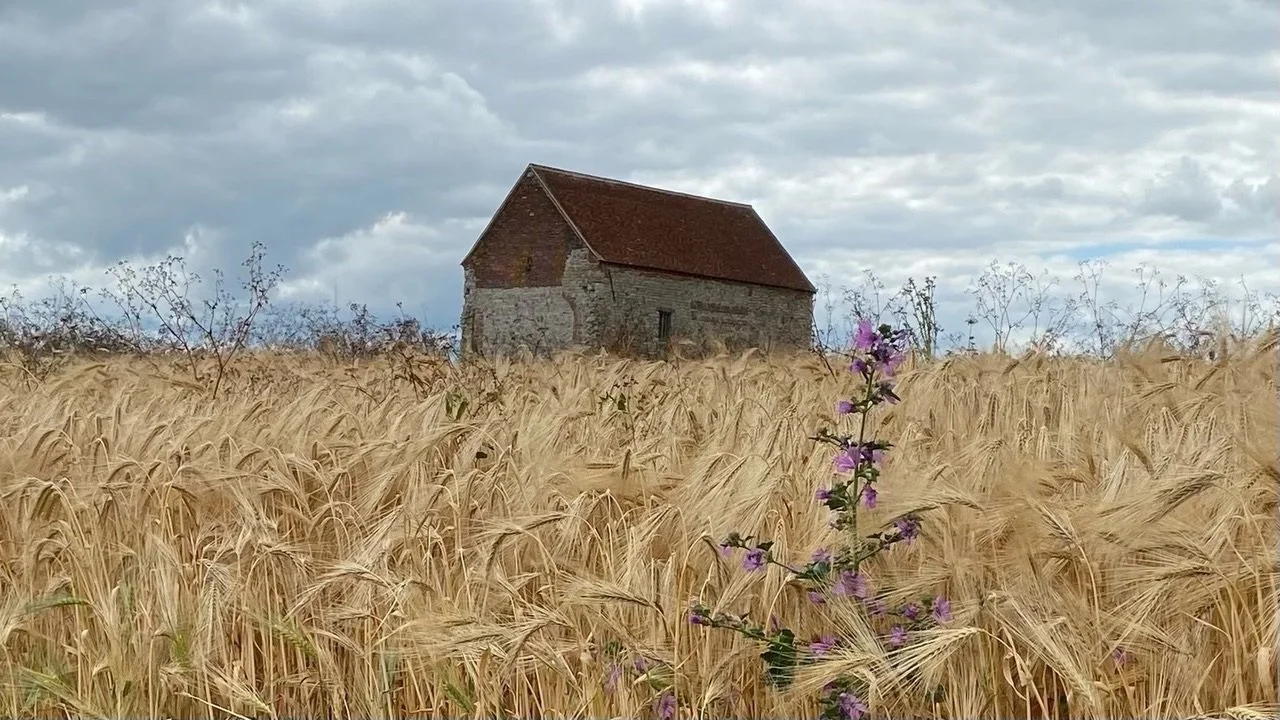


This small chapel is the Chapel of St Peter-on-the-Wall. It is located on an isolated bit of coastline in the southeast of England. In 653 St Cedd sailed down the east coast of England from Lindisfarne and landed at Bradwell. Here he found the ruins of a deserted Roman fort and constructed the chapel that is still standing today. It is still an active place of worship and is the home chapel to the nearby Orthona Community. There is an annual pilgrimage and gathering at the chapel which includes a walk from the nearby St Thomas church, music, prayer, talks, nature and fellowship. Our Bishop, the Bishop of Bradwell had this to say of the pilgrimage...many of us know the value of a purposeful journey, one taken for a reason greater than simply another transaction. Our forbears have good things to teach us, not least about becoming attuned to the rhythms of grace as we move across the landscape to connect with it and with our creator.’ I became aware of the chapel long before I showed any interest in Christianity. I am a keen cyclist and I rode out to the chapel many times. It was always a pleasant ride through the countryside, with an interesting end point and unlike most churches and chapels in the UK, it is always open. It is one of the few places I have visited where there is absolute silence. The chapel has no electricity or running water so that silence is only ever broken by birdsong and the occasional visitor.
In 2015 I lost my wife to a traffic accident. Three months before that I had lost my mother suddenly to cancer. The loss of my wife led to what I can only describe as a mental breakdown. I would go days without sleep and experience auditory hallucinations. I became hyper sensitive to sound and cut off all human contact. The only relief I could find would be rides out to the chapel and the silence it offered. There was never for any religious reason for my visits given days without sleep and being susceptible to hallucinations what I remember happening next may be subject to distortion but it is how I remember it. Like many other times I had cycled out to the chapel. It was an overcast and very grey day. Thick dark cloud and threatening rain. I took my usual place at the back, closed my eyes and tried to rest and loose myself in the silence. I had not noticed at first but a bible and been left behind right next to me. I had never taken the Bible seriously before, having been raised by atheist parents. I picked it up and started reading at a random point. I don’t really know how long I had been reading, 15 minutes maybe when from inside the chapel it looked like weather had drastically improved. The windows of the chapel are extremely high up and sunlight seemed to be streaming down at a 45 degree angle. I went outside expecting to see a break in the clouds but it was still dark grey and overcast. I went back inside and continued to read and after a minute or two, sunlight began streaming through the windows again. This repeated a few times, inside sunny but outside dark overcast. I couldn’t make sense of what I was seeing and stayed there for hours. I don’t remember the journey home but the next day I started to look into Christianity for the first time. Regardless of what really happened, I felt I had a religious experience but wasn’t really sure what to do about it. Not knowing where to start, I contacted the biggest local church. It happened to be a Catholic Church but after a month or so I started looking elsewhere. I took the scenic route to Anglicanism,spending time with Mormons, Jehovah Witnesses, Quakers, just about every denomination that had a local presence. The bizarre thing is that the is an Anglican Church at the bottom of my garden and I never considered going there until after experiencing all of the alternatives. That is now the church I call home, where I was Baptized and Confirmed and where I now serve at churchwarden, parish safeguarding officer and now we have entered interregnum, I lead a morning and evening prayer service twice a week. This church is also called St Peter’s and although it has very much become my church, since joining the congregation I have always had a feeling of being nudged towards something more. It has taken much prayer and searching but I believe that something more is the Community of Francis and Clare.
Paul Dicker (CFC Candidate)