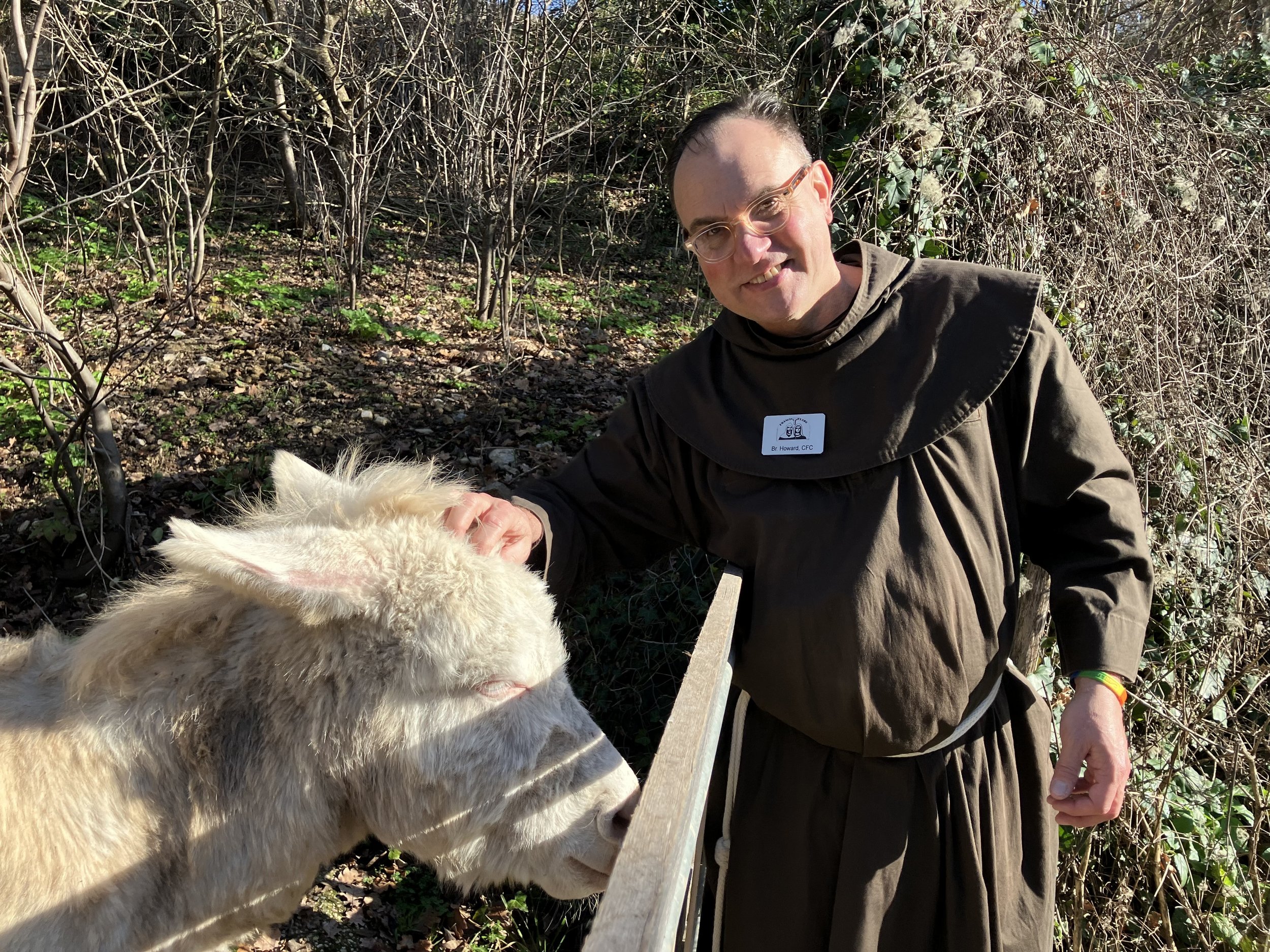
Br. Howard N. Dana
As people who have been to Assisi, Italy know, it is a dramatic place. The medieval walled town rises on a hilltop where the Romans founded a settlement in 295 BCE—over 2,300 years ago. The church in Assisi’s main square still has the façade of the Roman Temple to Minerva. Though expanded over the years the town walls rise as imposing as ever. And above it all an ancient fortress commands the high ground, strategically placed to detect attacks from all directions. While peaceful and beautiful now, fortified Assisi is still ready to defend itself. It is ready to offer safety and security within its walls. But its security comes at a price. In ancient Assisi, the wealthy were in control of the town and all it contained. Their grand homes sat on the nicest plazas. Their dead were buried in church crypts. Their children wanted for nothing. As long as things happened within the walls of Assisi, they were safe and predictable. And then along came Francis and Clare.
Born around the turn of the 13th Century, both Francis and Clare had wealthy, powerful parents. Each had parents who wanted them to be cultured, educated, and ready to carry on the family business. Their parents wanted safety and security for their children. But neither Francis nor Clare wanted that. Each understood what lay outside the walls of Assisi. And each longed for a more daring life than their parents had in mind. As safe as it was within Assisi’s wall, the vast agricultural plane below the city was a daring, dangerous place. As we remember from grade school history classes, in those days people did not live where their fields or flocks were. Mideval houses were clustered in villages and towns. Each day people set off with their flocks or to their fields, returning to safety again each night. In Francis and Clare’s day walking along a road at night could get you robbed or worse. Soldiers from neighboring towns might invade your fields. Lepers and other social outcasts were not allowed within the town walls, so they fended for themselves on the plane. So, to turn their backs on Assisi and all its safety was the first radical move both Francis and Clare made. They chose a daring life over a safe one. And in this choice, they have much to teach us, a people obsessed with safety and security. To find a life worth living, both Francis and Clare had to turn their backs on all that was safe and secure. They went so far as to embrace poverty, relying exclusively on charity from other people to live. This, of course, enraged their wealthy, status-seeking parents!
After their deaths, Assisi built enormous churches to house the bodies of St. Francis and St. Clare. It is quite moving to sit in the beautiful space where Francis’ remains are interred with five of his closest friends. Clare’s tomb is different—and equally moving. As one sits in the quiet of a beautiful chapel near the body of a saint, it is too easy to imagine the person was going to automatically end up being admired. But this was never the case with Francis and Clare. When they were alive, both were scorned by Assisi, if not outright despised. Neither was very welcome within the town walls. Their respective ministries were carried out on the dangerous plane below Assisi. It was in a small, run down chapel at the edge of a field that Francis gathered his first few brothers. It was in that same small chapel that he and these brothers welcomed Clare the night she ran away from home. As she professed her desire to follow their work, they arranged for her to be protected in a nearby monastery. They also fulfilled her requests to have her nice clothing sold for the poor—and her beautiful hair cut off. There was no going back to the safety and conformity of Assisi. Living off charity and working with nearby lepers was the path now. No longer did the material world hold either Francis or Clare. Once safety was gone, they were free to be the Christians they wanted to be.
Franciscan theology says we do not have to go looking for God—God comes looking for us. It also implies that if God comes looking for us, when God finds us God will have plans for us.
It would be a mistake to think following Francis and Clare requires a kind of 13th century LARPing—that’s Live Action Role Playing for us older folk. To be a Franciscan is not about dressing up in a costume and pretending to live a poor and selfless life—though the costume is sometimes helpful. It is about turning one’s gaze from the expected to the marginalized. Franciscans have eyes for the poor. They have eyes for suffering and injustice. They have eyes for animals, both wild and domestic. They have eyes for the earth and the perils of climate change. Franciscans need not look different from everybody else, but we must act differently. We must not let safety get in the way of doing what is needed. Daring is required.